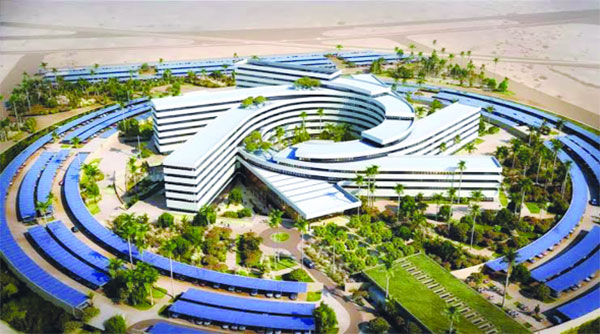
For the very first time in its history, the United Nations family celebrated the 81st anniversary of the UN Charter in its brand-new House in Diamniadio. Bringing together diplomats, members of the Senegalese government and international civil servants, this historic event marks the moment a reinforced multilateral synergy, resolutely focused on young people and digital sovereignty, becomes a concrete reality.
A historic first at the heart of the city of the future: this is a major turning point for diplomacy and multilateralism in West Africa. On Friday 23 October 2026, United Nations Day took on a special lustre in Senegal. For the first time since its inauguration and the official signing of the occupancy agreement on 12 June in the presence of Amina J. Mohammed, UN Deputy Secretary-General, the celebration was held in the ultra-modern complex of the United Nations House in Diamniadio. In a 500-seat auditorium that was almost full, the diplomatic corps, government representatives and leaders of the UN system gathered to mark the organisation’s 81st anniversary. It was a moment of solemnity, enthusiasm and pragmatism.
Opening the ceremony, the Resident Coordinator of the United Nations System in Senegal, Ms Aminata Maïga, welcomed the guests with a warm phrase: “Make yourselves at home.” Highlighting the symbolic and operational significance of this infrastructure built by the Senegalese State, she declared: “This house is much more than a building. It embodies an ambition: that of a United Nations that is more united, better coordinated, more effective and closer to the people. By celebrating our anniversary in this house today, we are opening a new chapter in our partnership with Senegal, under the banner of unity, innovation, effectiveness and solidarity.”
This vision struck a strong chord with the diplomatic corps. Speaking on its behalf, Mr Jean-Luc Aka-Evy, Ambassador of the Republic of the Congo, summed up the collective relief and pride: “Madam Coordinator, I was going to say: ‘Phew, at last, we are at home.’” Invoking the African philosophy of ubuntu (“I am because we are”), he hailed the premises as a true “house of humanity”.
The Senegalese State’s firm commitment
Alongside his counterpart responsible for Agriculture, Cheikhou Oumar Ba, the Minister of African Integration, Foreign Affairs and Senegalese Abroad, Cheikh Niang, reaffirmed the constancy of the State’s commitments: “Senegal remains attached to the ideals of peace, justice and prosperity that you pursue every day. That is the whole point of building the United Nations House.” The former Permanent Representative of Senegal to the UN in New York reassured the international community of the government’s support in the process of relocating staff to Diamniadio, guaranteeing the follow-up needed to enable each agency to carry out its missions in optimal conditions.
For her part, Ms Maïga was keen to underline the political will driven at the highest level by the President of the Republic, Bassirou Diomaye Faye, confirming Dakar’s central status as an essential regional hub hosting country agencies, regional offices and the United Nations Office for West Africa and the Sahel (Unowas).
Held under the theme “The UN and digital technology: accelerating youth employment and empowerment in the age of Artificial Intelligence”, this 2026 edition lies at the heart of current societal concerns. A few days after fruitful discussions with students at the African Centre for Higher Management Studies (Cesag), the speakers stressed the dual nature of AI.
Mr Cheikh Niang recalled the Technological New Deal, the national strategy championed since February 2025 by President Faye to raise the digital sector’s contribution to 15% of GDP by 2034 and create 350,000 jobs. Faced with concerns about the impact of algorithms on the labour market, the minister sought to reassure: “What is problematic is more the use to which AI can be put than the tool itself.” He therefore called on the UN to support ethical governance for an inclusive and humanist use of technology, while recalling the imminent opening of the Youth Olympic Games (YOG Dakar 2026), scheduled for 31 October.
Global security and
synergy among stakeholders
For his part, Leonardo Santos Simão, head of Unowas, recalled the strategic importance of regional integration: “In the face of challenges that transcend borders, cooperation is not a choice of circumstance. It is the very condition of our common security and prosperity. Security will not be won by weapons alone; it requires justice, education, employment and trust.” This solidarity was expressed at every level during the week: from the citizens’ blood drive organised by staff to the notable speeches by the president of Funsa (Oumar Coulibaly) and the president of Asafi (Abdou Khadr Diakhaté), who pertinently pointed out that “experience does not retire” in the face of technological change. The concrete opening of the first operational offices by the UN’s bank, the Unfcu, represented by Timothy Challen, sealed the site’s immediate viability. The celebration ended on a poignant cultural note: a play by the famous Kocc Barma theatre troupe from Rufisque. Through their acting, these artists invited Senegalese youth to seize the digital age with creativity, boldness and resilience.
Comments (0)
Be the first to comment.
Sign in to comment