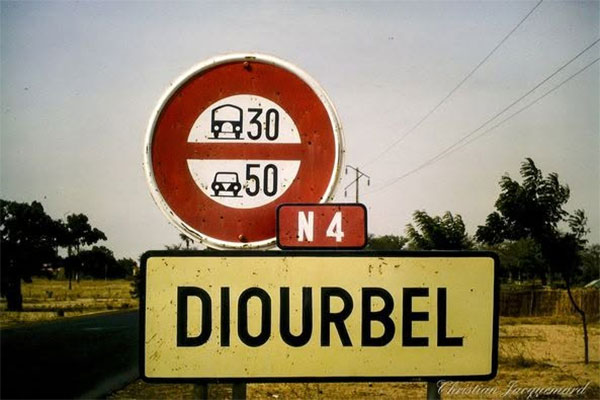
Because of its geographical location at the heart of the groundnut basin and less than 50 km from Touba, the most populous city in Senegal after Dakar, Diourbel presents a paradoxical economic and social profile.
Endowed with significant economic, agricultural, commercial, artisanal, agro-industrial and poultry-farming potential, the town nonetheless struggles to rally its young people around a genuine, structuring development ambition capable of keeping them on its territory. The cities of Touba to the east and Dakar to the west act as suction pumps draining Diourbel of its substance, its youth and, consequently, the vitality of its population.
Fortunately, however, this dark picture is lit by a radiant sun that casts its rays over the whole department and well beyond. That is to say that Diourbel is full of potential which, until now, has been slow to be exploited, hence the title of this article: what levers of territorial development for a town like Diourbel?
The aim, of course, is to move from the diagnostic stage to that of proposals.
This choice of method is explained by the fact that numerous reports, studies, notes and assessments have drawn up an economic, social, tourism and industrial inventory of the town, all reaching the same conclusions: a trend towards impoverishment owing to rural and urban exodus, poor soils and an almost non-existent industrial base.
In a study published by Anat reporting on the work of the sharing day with the executives of the Diourbel-Louga territorial hub, the hub’s potential was presented, in contrast to the bleak picture of an abandoned Diourbel without resources.
It must be admitted that the challenges of territorial governance and the requirements of alignment with national policies on economic sovereignty and local development have so far been lacking to propel Diourbel into the leading pack of attractive towns.
To do so, it is imperative to identify these levers from a territorial development perspective by betting on sectors that bring hope.
As we said earlier, Diourbel’s geographical position, with its proximity to Touba, is not sufficiently exploited to benefit from it. Indeed, with events of international scale such as the Magal of Touba, which welcomes more than 7 million pilgrims, sectors such as livestock farming, horticulture, crafts, hospitality, transport and better-regulated trade should constitute powerful strategic levers with real economic spin-offs. As a host territory, Diourbel has a fine card to play in accommodating pilgrims in better conditions of comfort and safety, for those who choose the tranquillity of the town and the quality of its transport services and commercial facilities.
In a benchmark economic impact study conducted jointly by Université Cheikh Ahmadou Bamba of Touba, Université Alioune Diop of Bambey and the organising committee of the Grand Magal of Touba in 2026, the overall economic impact of the Magal of Touba was estimated at nearly 630 billion CFA francs, or just over 8% of Senegal’s budget for the same year!
The study highlighted the main spending areas, such as food, accounting for nearly 225.52 billion, and livestock, a sector that generated 33 billion, corresponding to more than 100,000 ruminants. Retail trade and the informal sector are not to be outdone, with some local traders even reporting turnover reaching up to 70% of their annual income.
With all this wealth created, one may logically ask what share Diourbel has been able to capture.
But Diourbel is not only about the wealth opportunities linked to the Magal. All those nostalgic for the old days cannot fail to remember the great Seib, the Société électrique et industrielle du Baol, which has today become Sonacos. Several factors are holding back its growth and the factory is struggling to regain its former lustre. From obsolete industrial equipment to shortages of raw materials, by way of stagnant agriculture, cash-flow problems and a notable shift of the groundnut basin, the flagship of Diourbel industry, which was the pride of the town, could only run out of steam.
By comparison with the capital of Senegal, the Dakar region accounts for 91% of the national industrial base, while Diourbel has only 4 to 5 industrial units in operation, according to Ansd’s General Census of Enterprises (Rge)1. This disparity seems incomprehensible in a context of territorialisation of public policy and of reversing Dakar’s macrocephaly.
It seems imperative to me to build a new strategy to revitalise the Sonacos factory, given its decisive contribution to job creation, to the development of sport through the team of the same name, and to the image of a dynamic and hopeful town.
As an engine of economic activity, the revival of Sonacos should give rise to new hope and shape a new approach to the development of the Diourbel territory, enabling the town to position itself more strategically in the national economy.
This destiny as a dynamic and lively town should draw on as yet little-exploited potential such as agribusiness, horticulture, fish farming, and religious and cultural tourism.
The context of the development of territorial hubs initiated by the Minister of Urban Planning, Local Authorities and Spatial Planning is an opportunity in view of the stated ambitions, the structuring investments envisaged and the imperatives of breaking down territorial barriers.
Once territorial boundaries are no longer a handicap to implementing agricultural modernisation and agribusiness development projects, the planets are well aligned, provided the right choices are made and the adverse effects of climate are mitigated.
Current initiatives are certainly welcome, notably the expansion of modern farms along the Diourbel-Touré Mbounde axis towards the toll motorway, but they remain timid in view of the expanses of land condemned to serve only rain-fed farming. I will not go so far as to say that we have not yet become masters and possessors of nature, but we may well admit our timidity in lifting climatic and hydrological constraints, and in unlocking the secret of water, taming it and using it beyond the 3 months of rain.
Pending the great water transfer which, I hope, will irrigate the whole of Baol, actions to revitalise the Sine valley and an intensification of the retention basin policy could make Diourbel a land of market gardening once again, as it was in the 1960s and 1970s.
It is a paradox to have a population that is 75% young, to have arable land, sunshine reaching 3,000 hours a year and a population nourished by the Mouride philosophy of work, and yet to be ranked among the poorest regions of Senegal.
What about religious tourism? How can it be that the town which hosted the founder of Mouridism, the venerated Cheikh Ahmadou Bamba, for nearly fifteen years cannot develop religious tourism?
How can one explain the little interest shown in the Great Mosque of Diourbel on Senegal’s tourist map, when it is the only mosque undertaken by the founder of Mouridism, begun in 1918 and completed in 1925, two years before his return to God; and, what is more, a UNESCO World Heritage site?
And what can be said of the Cheikh Ibra Fall neighbourhood and his main residence, where personal belongings of Cheikh Ahmadou Bamba’s most faithful companion are still kept? The night of Lamp Fall (Gouddi Mame Cheikh) was for years a national event that brought to Diourbel thousands of Baye Fall and disciples who came to celebrate the occasion.
Culturally, Diourbel has significant cultural potential made up of historic sites and monuments to be showcased, such as the Mbanaar of Ndayane, the village of the scholar Cheikh Anta Diop some 50 km away, the annual Gamou of the Laobés at Séssène and the annual divination gathering, or “xooy”.
As for horticulture, the prerequisites for positioning it, along with market gardening, as engines of income and of jobs for young people and women involve lifting the constraints of poor-quality, highly saline irrigation water and soil degradation. To this end, with well-designed inter-municipal cooperation, the lands of Touré Mbonde and Ngohé remain powerful receptacles for horticultural gardens. The combined strategy of technical training with the Diourbel Cfp, organisational support (with community cooperatives) and financing (Fongip, 3Fpt, Anida…) can fit into a territorial economic vision focused on innovation, partnership and inter-municipal cooperation. It should be noted that all these levers are important to make Diourbel a town worthy of a regional capital. But thinking about the town’s competitiveness while relegating the issue of infrastructure (cultural, sporting and urban roads) to the background is not an option.
Cultural facilities such as a “Mbayard museum”, named after Diourbel’s traditional name, or neighbourhood playgrounds, aquatic facilities and other municipal swimming pools, and a street-paving programme are factors of territorial attractiveness, as well as creating jobs for young people and shaping sporting and cultural destinies.
And it is common knowledge that any vision of territorial development is driven by strong leadership that is aware of the stakes, committed and ambitious, open and results-oriented, capable of creating synergies of actors and actions in the service of a genuine urban project. The question of governance arises here with all its acuity. Moreover, the choice of the men and women who are clearly aware of the challenges of the hour and capable of leading Diourbel’s renewal, rousing it from its torpor and positioning it on the national political and economic chessboard, must be made with rigour and responsibility as the municipal elections approach.
Dr Cheikh FALL
Lawyer and expert in territorial development
Quartier Keur Cheikh – Diourbel
fallchekhna@yahoo.fr
1 www.ansd.sn/Indicateurs/resulats-du-recensement-général-des-entreprises-rge
Comments (0)
Be the first to comment.
Sign in to comment